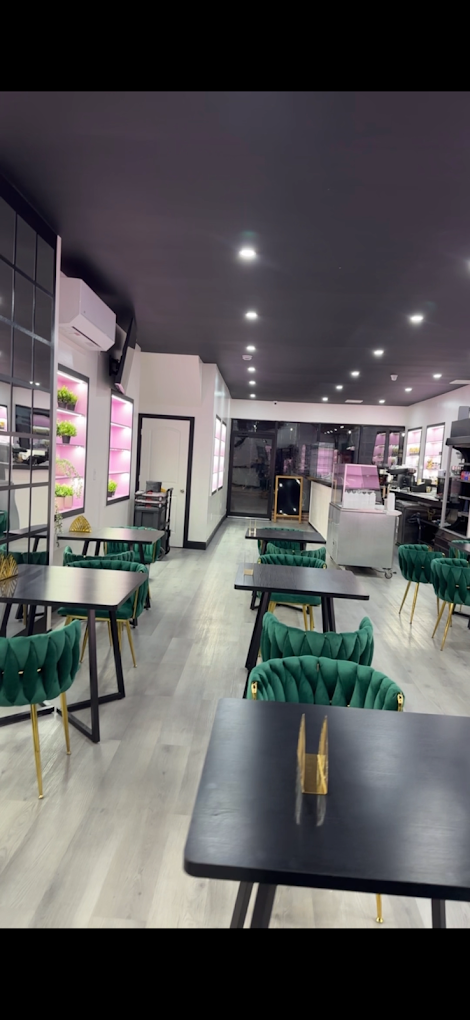
Bushwick has been three different neighborhoods in living memory. The cafe owners who don't acknowledge that — who treat 2026 Bushwick as if it sprang up in 2015 — get it wrong. Here's a short, honest history of where the neighborhood has been, what it is now, and what we're trying to keep alive at Café Mia.
1860–1960: Industrial Bushwick
Bushwick was originally a Dutch town, then a brewery district. By the late 19th century there were 14 breweries operating within the neighborhood — Bushwick was, briefly, the brewing capital of America. The factories along Bushwick Avenue and Broadway employed German, Italian, and Polish immigrants who lived in the row houses we still walk past today.
The brewing era ended with Prohibition. By the 1950s most factories had become light-manufacturing or warehouse spaces, and the neighborhood was a working-class, predominantly Italian and Puerto Rican community. The architecture from this period — wide brick warehouses, ornate Victorian row houses, broad commercial streets — is what gives Bushwick its bones.
1960–1990: Disinvestment
The post-war flight to suburbs hit Bushwick hard. Factories closed. The 1977 blackout looting devastated the commercial corridors along Broadway and Knickerbocker. Insurance fires in the late 1970s left scars that took decades to heal. By the 1980s Bushwick was a neighborhood the city had largely written off — high crime, abandoned buildings, vacant lots.
The community that remained — primarily Puerto Rican and Dominican families, plus the long-term Italian residents — held the place together. The bodegas on every corner, the social clubs, the community gardens that took over abandoned lots: these are the institutions that kept Bushwick a neighborhood when official resources had moved elsewhere.
1990–2010: The artist migration
Williamsburg gentrified first. The artists priced out of Williamsburg moved one stop down the L line to Bushwick, where rent for a 2,000-square-foot loft was a fraction of what it was in Williamsburg. By 2003, Bushwick had a real artist population. Open studios. Warehouse parties. The earliest galleries.
This was the period when "Bushwick" started showing up in the New York Times in a non-crime context. The framing was always slightly anthropological — "the next Williamsburg," "the new bohemia." The framing missed that Bushwick wasn't a blank canvas; it was a neighborhood that had been a neighborhood for 150 years and was now adding a new layer.
Every neighborhood that's been called "the new Williamsburg" was already something before the comparison.
2010–2020: The food and coffee wave
The galleries brought a customer base. The customer base brought restaurants and cafes. Roberta's opened in 2008 and became the cultural reference point for what Bushwick dining could be. By 2015, Bushwick had multiple critically acclaimed restaurants, a real coffee scene, and a Saturday night nightlife corridor that drew customers from across the city.
The neighborhood's identity got more complicated during this period. The original residents were displaced or pressured by rising rents. The new residents — younger, whiter, more transient — sometimes treated Bushwick as a backdrop rather than a community. There was real tension. Some of it remains.
What survived through this period: the bodegas, the social clubs, the community gardens, the long-term residents who own their buildings. Bushwick didn't get erased the way Williamsburg got erased. The bones of the older neighborhood are still here.
2020–2026: The current moment
The pandemic accelerated trends that were already happening. Restaurants closed; some never reopened. Pop-ups became permanent. Outdoor dining permanently changed Knickerbocker and Wilson. Remote work changed what people wanted from a cafe — longer stays, more food, less coffee-and-go.
Right now Bushwick is in a kind of equilibrium. Rents are still high but stabilizing. The newer residents have been here long enough to be neighbors rather than tourists. The cultural infrastructure — galleries, music venues, restaurants — is mature. There's a real local pride that wasn't there in 2015.
Café Mia opened in 2025. We're part of the current wave, but we're consciously not trying to be a "scene" cafe. We're trying to be a neighborhood cafe — the kind of place that fits into Bushwick's existing rhythm rather than imposing a new one on it.
What we're trying to preserve
When Arty and Dilyara built Café Mia, the design choices reflected an opinion about Bushwick:
- The cafe is welcoming, not exclusive. No "members only" energy. No password. The room reads warm to anyone who walks in.
- The pricing is fair. A latte at Café Mia costs what a latte at any Bushwick specialty cafe costs. We don't surcharge for atmosphere.
- The staff are local. Hires come from the neighborhood when possible.
- The food respects the audience. We're not adding $24 brunch plates. The avocado toast is good and costs $10.
- The cafe operates on Bushwick time. Open at 8 AM (when neighborhood workers and locals start their day), not 10 AM (when the influencer crowd arrives).
What's at risk in Bushwick now
The threats to the neighborhood aren't dramatic. They're slow:
- Rent pressure on long-term tenants and small businesses.
- Cultural homogenization — every new business looking and feeling the same.
- Loss of physical landmarks — the corner store that's been there for 40 years closing because the owner retired and no one took it over.
- Tourism overshadowing local use — the murals becoming a backdrop for selfies, then losing the energy that made them culturally meaningful.
None of these are things a single cafe can solve. But they're things a cafe can avoid contributing to. Café Mia tries to.
What you can do
If you're new to Bushwick: spend money locally. Tip well. Learn the names of the bodega owners on your block. Don't treat the neighborhood as a film set. Show up on weekday mornings as well as weekend nights.
If you've been here forever: thank you. The reason there's anything good here at all is the residents who refused to leave during the harder years.
If you're visiting: stay long enough to actually look. The murals are great, the cafes are great, but the things that make Bushwick worth visiting are the in-between things — the parks, the corner stores, the residential blocks. Walk those.
And if you want to start with us: 1128 Broadway, two minutes from the J/M/Z. Open daily 8 AM – 5 PM. Welcome.
Frequently asked questions
How long has Bushwick been a neighborhood?
Bushwick has been settled since the 1660s, originally as a Dutch town. The current neighborhood character developed over the last 160 years through waves of German, Italian, Puerto Rican, Dominican, and most recently artist migration.
When did Bushwick start to gentrify?
Around 2003–2008, when artists priced out of Williamsburg began moving one L-stop east. The food and coffee wave followed in the early 2010s.
What was Bushwick known for historically?
Brewing — at its peak, 14 breweries operated in Bushwick, briefly making it the brewing capital of America. The Victorian and brick warehouse architecture from that period still defines the neighborhood.
Is Bushwick a safe neighborhood?
Yes — modern Bushwick is well-trafficked, well-lit, and one of the safer neighborhoods in this part of Brooklyn. Standard NYC awareness applies.
Where can I learn more about Bushwick history?
The Brooklyn Public Library has a Bushwick neighborhood archive. The Bushwick Historical Society hosts walking tours. Several local independent newspapers have published deep dives over the past decade.