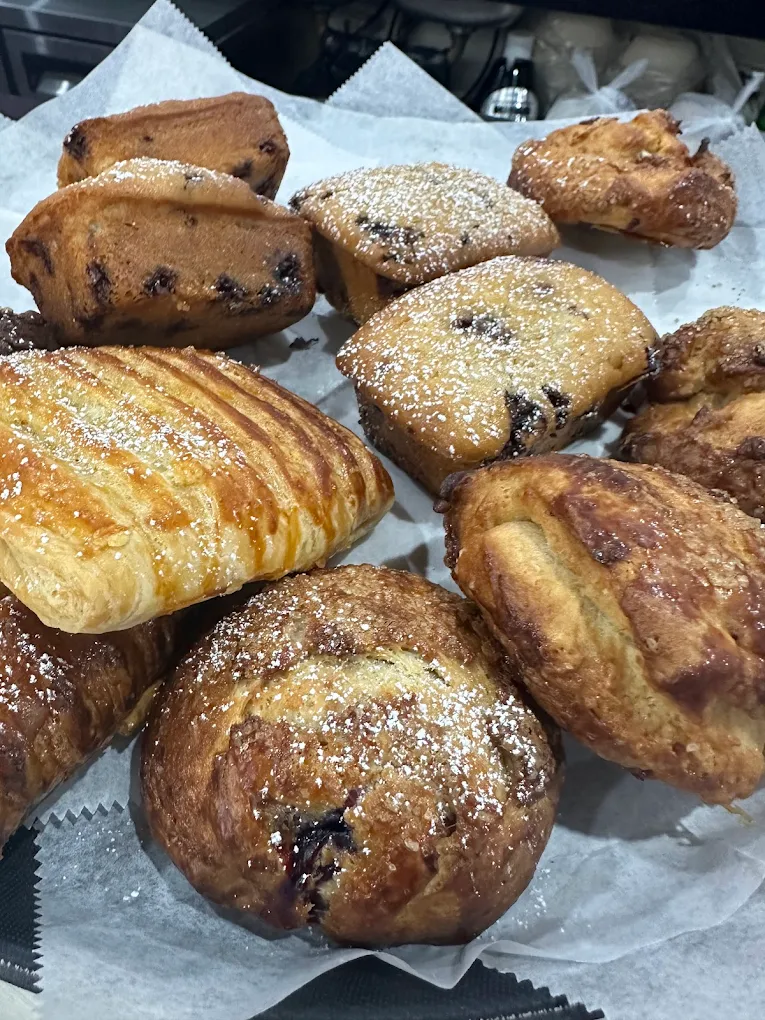
Most cafes don't bake their own pastries. They get a daily delivery from a wholesale bakery, set the pastries in a case, and call it good. Café Mia bakes ours in-house every morning. Here's what that actually looks like — the routine, the reasoning, and why it matters in the cup, on the plate.
The morning bake
Our pastry kitchen starts at 4:30 AM. By the time the cafe opens at 8, the croissants are still warm, the danishes are out of the oven within the last 90 minutes, and the muffins have been sitting just long enough to set.
Most days produce 80–120 pastries. About 60% are croissants in various forms (butter, almond, chocolate, seasonal), 25% are muffins and scones, and 15% are seasonal items like danishes, sticky buns, or shortbread.
What's harder than people think
Croissants take three days. Day one: make the dough. Day two: fold in the butter (this is where most home bakers fail — the butter has to be exactly the right temperature, and the dough needs to rest between folds). Day three: shape, proof, bake. The croissants you eat at 9 AM Tuesday were started Saturday afternoon.
Lamination — the layering of dough and butter — is what gives croissants their flake. Our croissants have 81 layers of butter. You can taste the difference between a 27-layer croissant (typical of mass-produced bakery) and an 81-layer one. The 81-layer version melts; the 27-layer version is more like a dinner roll with shape.
Good croissants are 30% recipe and 70% time.
The flour decision
We use a high-protein European-style flour for laminated doughs and a softer pastry flour for muffins and scones. The wheat character is different — French flour produces a more delicate flake; American bread flour produces more chew. We've tried both. The French flour is about $0.60/lb more, and we use about 25 lbs per week, so it's not a small choice.
Customers don't usually know what's in the flour. They just know the croissant tastes better than the one they had last week somewhere else.
The butter decision
European-style butter only. Higher fat content (82–84% vs. American's 80%), which means more lamination, less moisture, better flake. The price difference is also $1.50–$2.00 per pound vs standard butter. Worth it.
The seasonal pastry program
Our pastry case has two layers of items: year-round and seasonal. Year-round are croissants, the cookie of the day, basic muffins, almond shortbread. Seasonal rotates with the menu — strawberry-rhubarb in spring, peach in late summer, apple in fall, citrus in winter.
Seasonal items are the hardest to make consistent because the produce changes every week. The pastry chef has to taste the strawberries each delivery and decide if the macerated mix needs more or less sugar. There's no recipe that's perfect across an entire season.
What gets made each morning
- Croissant dough laminated and shaped (started 2 days prior, baked today)
- Almond cream / pastry cream made fresh that morning
- Muffin batter mixed and baked
- Scones cut and baked
- Cookies baked (different daily — chocolate chip, oat, peanut butter, ginger molasses, etc.)
- Seasonal danishes assembled and baked
- Pastry cream / glazes / streusel topping for the day
It's a tight 3-hour window between when the kitchen starts and when the cafe opens. Days when something fails — a batch of croissants that didn't proof properly, or a muffin batter that didn't rise — there's no plan B. Those mornings the case is lighter, and we have to be honest with customers about why.
The waste question
What doesn't sell by close usually goes to staff or gets donated. Pastries don't keep well overnight — a 24-hour-old croissant is technically edible but it's not what we want to be selling. The waste rate is roughly 10–15% of daily production. We accept it as a cost of fresh.
How customers can help
- Come early. Pastries are best in the first 4 hours. Saturday after 11 AM is when stock starts thinning.
- Ask if you don't see something. The case isn't always fully stocked. There may be more in the back.
- Order trays for events. 24 hours ahead. Helps the kitchen plan; gives you fresh pastries.
- Don't expect Sunday afternoon to look like Saturday morning. The case at 4 PM Sunday is going to be sparse. That's not the bake; that's a successful weekend.
What we don't do
We don't use frozen dough. We don't use pre-made fillings. We don't use pre-baked shells we just decorate. Every piece in the case was made in our kitchen that morning. It's a pretty unfashionable approach in 2026 but it's the difference customers come specifically for.
Come early. The croissants are best at 9 AM.
Frequently asked questions
Are pastries at Café Mia baked in-house?
Yes — every pastry in our case is baked in our kitchen each morning, starting at 4:30 AM.
How early do you start baking?
4:30 AM. The cafe opens at 8 AM, which gives the kitchen 3.5 hours to bake.
Why are your croissants different?
We use European-style high-protein flour, European-style butter, and 81 layers of lamination. The dough rests for two days before baking.
Do you use frozen dough?
No — everything is made from scratch in our kitchen.
What time do pastries typically sell out?
On weekends, sticky buns and apple turnovers (in fall) often sell out by 11 AM. Croissants and basics last longer.